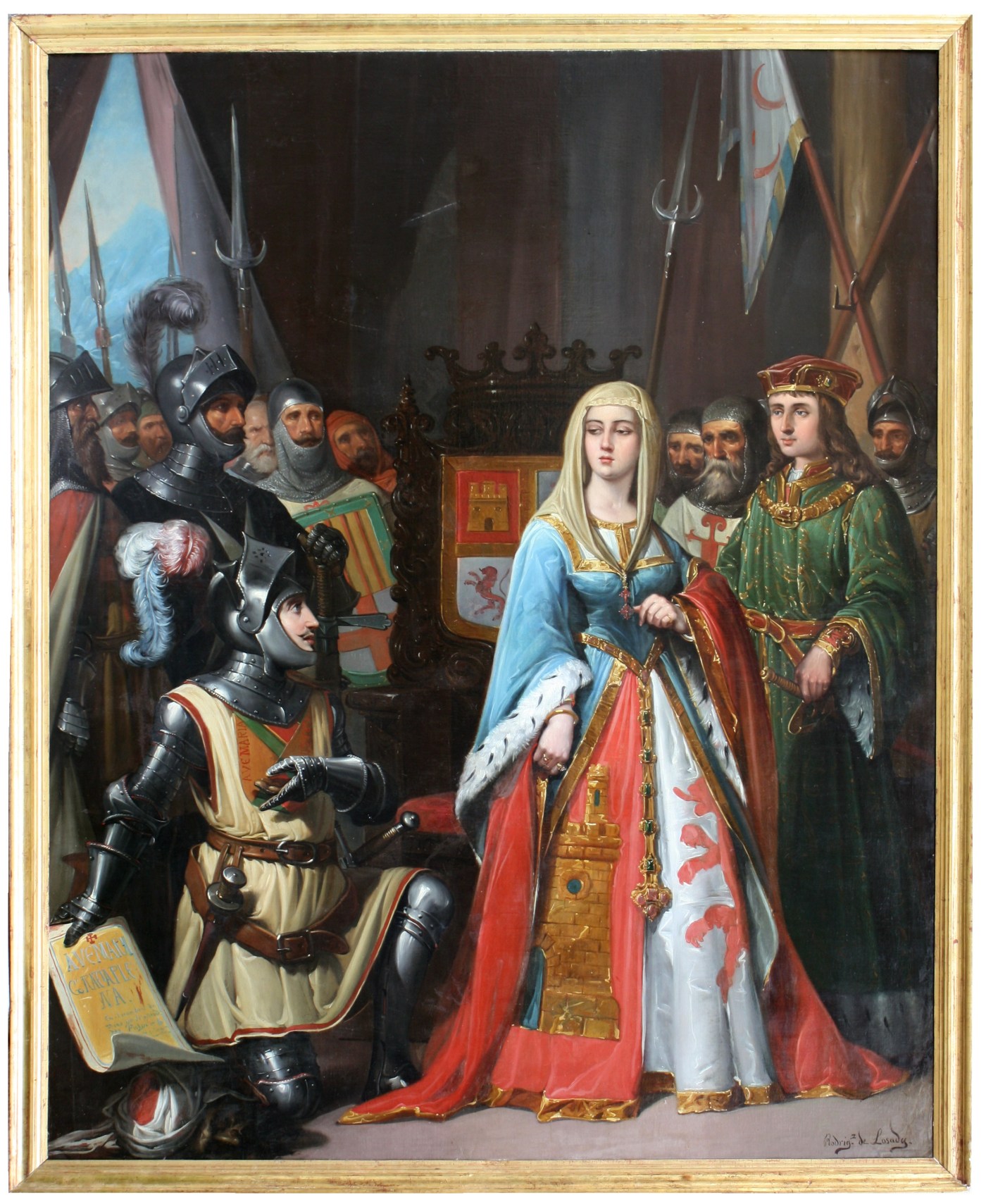
The Leadership of Isabella I of Castile (1451-1504) Was Key to Consolidating the Unification of Spain and Laying the Foundations of the Modern State. Her reign, alongside her husband Ferdinand of Aragon, the Catholic Monarchs, marked a decisive stage in the history of Spain. Below are the main aspects of her leadership, achievements, and key events:
1. Political Unification of Spain
Dynastic Union: In 1469, Isabella married Ferdinand of Aragon, which effectively unified the kingdoms of Castile and Aragon. Although both kingdoms maintained their own laws and administrative systems, their marriage was a decisive step toward the creation of a centralized monarchy.
Internal Stability: Isabella managed to consolidate her position as queen after winning the Castilian War of Succession (1475-1479), facing opposition from the nobility and the dynastic claims of Juana la Beltraneja.
2. Reform of the Administrative and Judicial System
Strengthening Royal Power: Isabella promoted the creation of a centralized state by reducing the power of the nobles and strengthening royal institutions.
Judicial Reforms: She established the Santa Hermandad, a police force tasked with maintaining order in rural areas and ensuring justice.
3. Territorial Expansion
Reconquest of Granada (1492): Isabella and Ferdinand concluded the Reconquista with the capture of the Nasrid Kingdom of Granada, marking the end of Muslim rule in the Iberian Peninsula.
Conquest of the Canary Islands: During her reign, the incorporation of these islands into the kingdom was completed.
4. Discoveries and Overseas Expansion
Sponsorship of Christopher Columbus: In 1492, Isabella financed Columbus’s expedition, which resulted in the discovery of America. This event paved the way for Spanish colonial expansion, transforming Spain into a global power.
5. Religious Reform and Religious Unity
Establishment of Catholicism: Isabella promoted religious unity as the foundation of her kingdom.
In 1478, with the Pope’s authorization, she established the Spanish Inquisition to persecute heretics and ensure Catholic orthodoxy.
In 1492, she decreed the expulsion of Jews who refused to convert to Christianity.
In 1502, a similar policy was applied to Muslims in the Kingdom of Castile. Her relationship with the Church earned her and Ferdinand the title of “Catholic Monarchs,” granted by Pope Alexander VI.
6. Matrimonial Policy and Diplomacy
Isabella used marriage as a political tool to strengthen Spain’s alliances in Europe:
Her children married members of the royal houses of Portugal, England, the Holy Roman Empire, and Burgundy.
7. Cultural and Educational Promotion
Isabella was a patron of the arts and education. She promoted the translation of classical texts into Spanish and supported the creation of educational institutions. Additionally, her court was an important cultural center of the Renaissance.
Legacy
Isabella’s leadership was characterized by her strategic vision, firmness, and ability to implement profound reforms. Her reign transformed Spain into a unified, centralized state with international projection. A woman of great faith, she defended the indigenous peoples as subjects of the crown, equal to European Spaniards.








 El Don Espiritual del Liderazgo Católico
Deja un comentario