The Spiritual Battle of the Christian: Invisible Struggle, Divine Weapons, and the Living Tradition of the Church
1. Introduction: a real war, though invisible
The New Testament presents the Christian life not as a mere ethic or a system of beliefs, but as a real, profound, constant struggle. It is not merely a psychological or social struggle, but a spiritual battle against forces that transcend the visible. This dimension, often forgotten in contemporary preaching, was central for the apostles and for the entire Tradition of the Church.
One of the most revealing texts is:
> “For we wrestle not against flesh and blood, but against principalities, against powers, against the rulers of the darkness of this world, against spiritual wickedness in high places” (Eph 6:12).
Here the enemy is precisely defined: it is not man, not a political or cultural adversary, but personal spiritual realities, organized and active.
And yet, this struggle has a particular feature that the New Testament itself emphasizes:
> “You have not yet resisted unto blood, striving against sin” (Heb 12:4).
That is to say, the combat is serious, but many Christians have not even entered its most intense phase. There is a call to move from a superficial faith to a conscious spiritual militancy.
—
2. Nature of the spiritual combat in the New Testament
The spiritual combat is articulated in three classical fronts, later systematized by Tradition:
The world (a mentality opposed to God)
The flesh (interior disorder)
The devil (a personal enemy)
Saint John summarizes it masterfully:
> “For all that is in the world—the lust of the flesh, the lust of the eyes, and the pride of life—is not of the Father” (1 Jn 2:16).
But the New Testament insists that behind this dynamic there is a personal intelligence:
> “Be sober, be vigilant; because your adversary the devil walks about like a roaring lion, seeking whom he may devour. Resist him, steadfast in the faith” (1 Pet 5:8–9).
Christ Himself is presented as the supreme combatant, whose mission includes the defeat of the devil:
> “For this purpose the Son of God was manifested, that He might destroy the works of the devil” (1 Jn 3:8).
The Christian, united to Christ, enters into that same battle.
—
3. “You have not yet resisted unto blood”: depth of the combat
The expression from Hebrews (12:4) is particularly strong. It indicates that the spiritual combat can reach total intensity, even martyrdom. But it also reveals a reality: many Christians have not even begun to fight seriously against sin.
This connects with another key teaching:
> “For if you live according to the flesh you will die; but if by the Spirit you put to death the deeds of the body, you will live” (Rom 8:13).
The combat is not optional. It is a condition of spiritual life or death.
Saint Paul even uses athletic and military language:
“Fight the good fight of faith” (1 Tim 6:12)
“I have fought the good fight, I have finished the race” (2 Tim 4:7)
The Christian life is not passive: it is an active asceticism, a cooperation with grace.
—
4. The spiritual weapons according to the New Testament
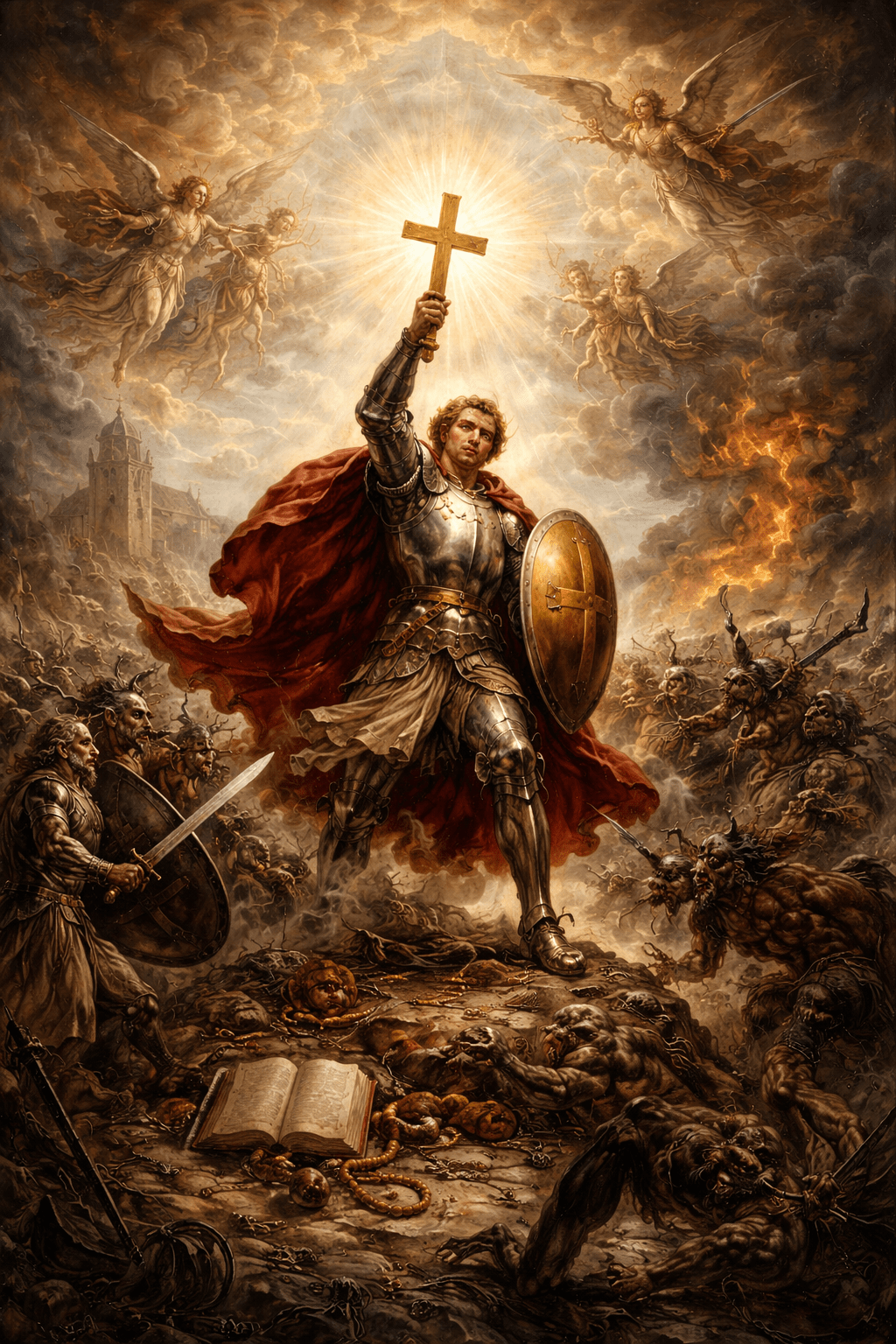
One of the most complete passages is Ephesians 6, where Saint Paul describes the armor of God. These are not decorative metaphors, but a true theology of combat.
a) Truth as belt
> “Having girded your waist with truth” (Eph 6:14)
Falsehood is the enemy’s weapon; truth frees and protects. This implies a deep adherence to revelation, not to shifting opinions.
b) Righteousness as breastplate
> “Having put on the breastplate of righteousness”
This refers to life in grace, moral rectitude, concrete holiness.
c) The Gospel as footwear
> “Having shod your feet with the preparation of the gospel of peace”
The Christian is not only defensive: he is missionary. He advances.
d) Faith as shield
> “Above all, taking the shield of faith, with which you will be able to quench all the fiery darts of the wicked one” (Eph 6:16)
Faith protects against temptations, doubts, interior attacks.
e) Salvation as helmet
Hope protects the mind from discouragement.
f) The Word of God as sword
> “The sword of the Spirit, which is the word of God”
It is the offensive weapon par excellence. Christ Himself uses it against the tempter (Mt 4).
g) Constant prayer
> “Praying always with all prayer and supplication in the Spirit” (Eph 6:18)
Without prayer, no combat is possible.
—
5. Other key texts on the combat
The New Testament is full of references that reinforce this vision:
Spiritual vigilance
> “Watch and pray, lest you enter into temptation” (Mt 26:41)
Self-mastery
> “I discipline my body and bring it into subjection” (1 Cor 9:27)
Radical renunciation
> “If anyone desires to come after Me, let him deny himself” (Lk 9:23)
Active resistance
> “Submit yourselves to God. Resist the devil and he will flee from you” (Jas 4:7)
—
6. The interpretation of the Tradition of the Church
The Fathers and spiritual masters have developed this doctrine deeply.
a) The Desert Fathers
The desert monks (3rd–4th centuries) lived the spiritual combat in a radical way. For them:
The enemy acts primarily through thoughts (logismoi)
Interior vigilance (nepsis) is key
Continuous prayer (especially the name of Jesus) is a fundamental weapon
Evagrius Ponticus describes eight principal thoughts (gluttony, lust, avarice, etc.), which later influenced the doctrine of the capital sins.
b) Saint Augustine
He emphasizes the struggle between two loves:
Love of God to the contempt of self
Love of self to the contempt of God
Spiritual combat is, at its core, a battle of loves.
c) Saint Gregory the Great
He develops the psychology of temptation in stages:
1. Suggestion
2. Delight
3. Consent
Sin is not in the suggestion, but in the consent.
d) Saint Thomas Aquinas
He integrates combat into his moral theology:
The devil cannot force the will, but can influence the imagination
Grace does not eliminate the struggle, but enables victory
e) Saint Ignatius of Loyola
In his Spiritual Exercises, he offers precise rules:
The enemy acts differently depending on the spiritual state
He uses deception, false consolations, discouragement
Discernment is essential
f) Saint John of the Cross
He deepens the theme of purification:
God Himself permits struggles to purify the soul
The spiritual night is also part of the combat
—
7. Ecclesial dimension of the combat
The combat is not individualistic. The Christian fights:
In the Church
With the sacraments
In communion with the saints
Especially important:
Eucharist: real strength against sin
Confession: restoration after the fall
Liturgy: participation in Christ’s victory
—
8. Contemporary relevance of the spiritual combat
Today, the combat takes on new forms:
Relativism → attack on truth
Hedonism → weakening of the will
Constant distraction → impossibility of vigilance
But the core remains the same:
a struggle for the soul, for truth, for union with God.
—
9. Conclusion: toward a militant awareness
The Christian is not a spectator, but a soldier of Christ. Scripture and Tradition agree on this:
There is a real enemy
There is a constant struggle
There are effective weapons
And there is a sure victory in Christ
But this victory is not lived without combat.
The warning of Hebrews remains актуal:
> “You have not yet resisted unto blood”
It is a call to awaken, to enter into the seriousness of the spiritual life, to move from a cultural faith to a combative, vigilant faith deeply united to God.
The Spiritual Battle of the Christian






 El Don Espiritual del Liderazgo Católico
Deja un comentario